
16th February 2026
As AI becomes increasingly common, many cos have started evaluating employees the way a consultant might evaluate a doorman
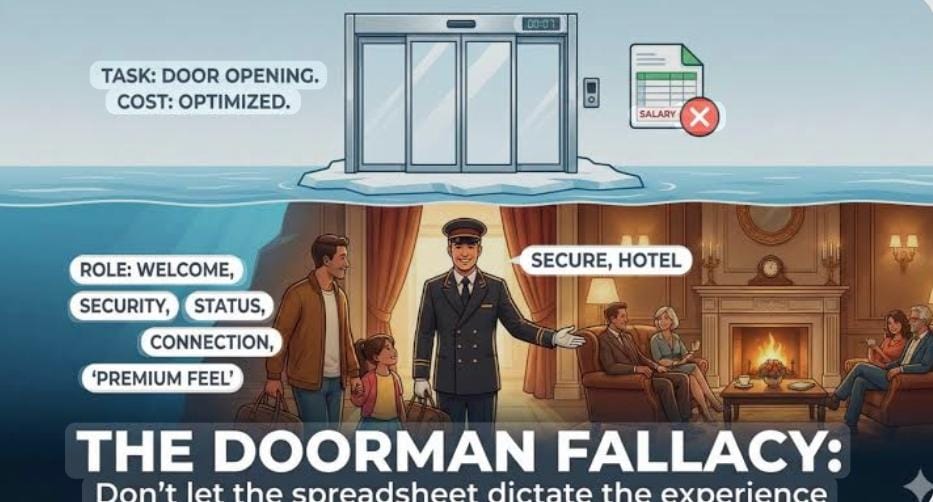
In his 2019 book, Alchemy, legendary British advertising executive Rory Sutherland offered an interesting lens on the perils of automation: Imagine you are the owner of a five-star hotel and you hire a consulting firm to come in & propose opportunities for efficiency improvements.
The consultant observes the operations of the hotel and suggests that the role of the doorman can be automated. He currently costs $40,000 per year. You can install an automatic door-opening mechanism and save that money annually.
You accept the proposal, fire the doorman, and install the automatic door.
But that’s not the end of the story.
“Two years later, the hotel’s a catastrophe, because the doorman was doing multiple things, many of which were human & kind of tacit. Security would be one. Hailing taxis, dealing with luggage, offering personalised attention to guests, providing status to the hotel, discouraging unwelcome behaviour—there are loads and loads of nuances & value creation components to that doorman which aren’t captured in the open-the-door definition.
Sutherland coined the term Doorman Fallacy to describe this phenomenon.
It arises when you ground your understanding of value in only the most visible function or skills, while failing to appreciate the full scope of tangible and intangible value that exists just under the surface.
In our business of Wealth Managenent; Apps, DIY investors and AI are already disrupting the role of Advisors & Distributors.
But, Wealth management is not only about managing the investment but managing the investor. It’s about keeping the investor away from fear & greed, about holding hands while riding the volatility, about keeping her away from mistakes & creating Alpha through compounding.
With AI-enabled efficiencies, automation, and job displacement top of mind, it offers a warning on the perils of the blind pursuit of efficiency.
Before we rush to automate or replace anything, the responsibility lies with all of us to slow down enough to develop a clear view on the Real Value being created by the thing rather than just the Surface Value we immediately see.
But this isn’t just a workplace problem. It shows up everywhere.
Every single day, you’re faced with opportunities to optimize some area of your life. As you do so, you make a simple mental calculation that weighs the costs and value of the action against the optimized alternative.
Many of the most meaningful things in life look inefficient when viewed through the wrong lens. But that doesn’t make them wasteful. It makes them human.
The doorman is much more than an automatic door opener.
Before you start removing your driver or peon or receptionist or replace cooking at home with a tiffin service, slow down, look deeper and always make sure you understand the Real Value before you replace something in the name of efficiency.
Avoid the ‘Doorman Fallacy’ & stay blessed forever.